4th Persona
In this week’s post, I will be writing about the fourth persona and what I believe to be an example of it from the show, Grace and Frankie. The fourth persona shows the audience a hidden message that only specific viewers could get. It is considered a “textual wink.” When one is “clairvoyant,” you understand what the message is- you get it. You are considered a “dupe,” if you miss the message.
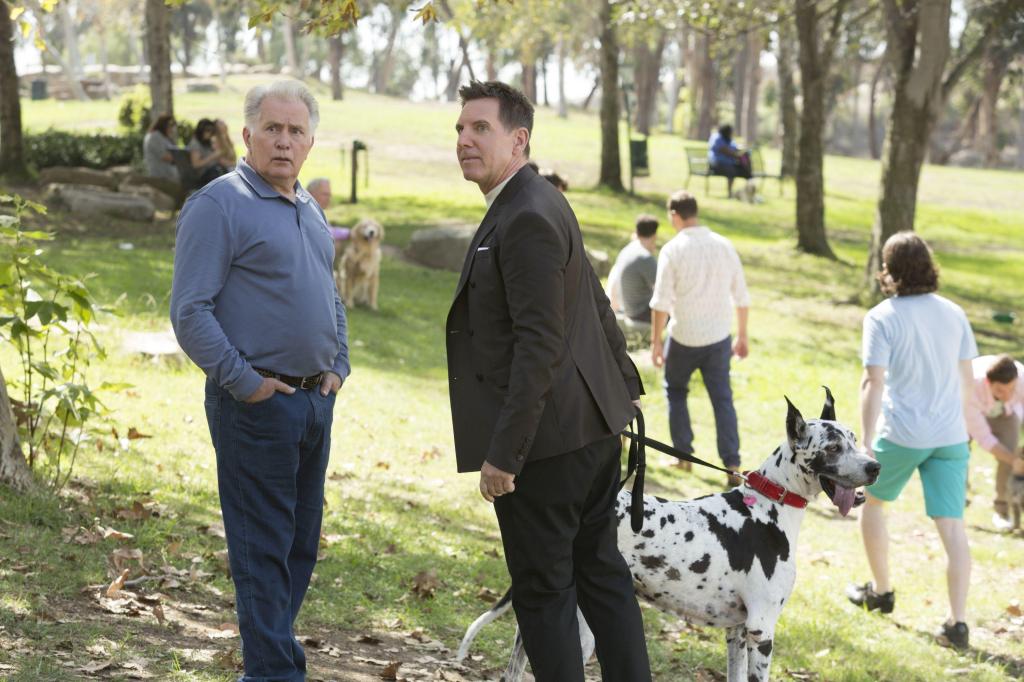
In season 2, episode 9, Robert and Sol are separated, because Sol cheated on Robert with his ex-wife, Frankie, which to Robert, is unforgivable and the absolute worst thing he could do. Robert’s friend Peter, (who is in an open relationship with his husband, Jeff), tells Robert he needs to get out of the house and to stop feeling sorry for himself over his separation with Sol. He makes Robert go with him and his dog, Tina, to the dog park. Robert soon realizes, “there’s not many women around here.”
For example:
Peter: “Because Tina needs to socialize and so do you.”
Tina is Peter’s dog and here Peter is trying to convince Robert that he needs to get out and socialize. What is implied here, is that Peter suggests that he needs to see who else is out there and to start meeting other men. Unless you knew Peter’s character from the previous episodes, the audience wouldn’t understand what Peter was really saying, if they just started watching, or if they were just a dupe.
Peter: “Okay, so he just signaled he wants to have sex with me.”
Robert: “What?! How did you get that?”
Peter: “Because ‘Hi’ meant with ‘Hi’ <nods head> sometimes means ‘well hellooo.’”
Here, Robert is the dupe. Peter is trying to explain to Robert what is really happening at the dog park and the real purpose of their visit, which is to see and/or sleep with other men. That is why the fourth persona is a key factor to this argument, because the audience might not even know what is really going on with these characters unless they are gay or understand gay lives. Robert is still new to being gay and so he is not clairvoynant to the messages implied at this particular park, either. The audience may be learning at the same time Rober’s character is learning about the different innuendos gay men may say to each other, that mean more than what is actually said.
In our class reading by Morris, he says, “…the motto of the fourth persona: it takes one to know one” (pg. 631). I believe this is true to this episode, because you have to know/be apart of gay lives to understand what is actually going on and being said. In this case, Robert was still new to the scene of publicly being gay, so even though he (was) is in a gay relationship, he didn’t understand at first what was going on and what was actually being implied, by going to the dog park. Which some audience viewers weren’t aware of this as well.
 Loni’s 142 Blog
I read this.
LikeLike
I read this!
LikeLike
The additional inclusion of character quotes serves as a helpful guide for me to follow along with the story despite not having watched the show myself. Good incorporation and example of a dupe. Application of fourth persona is articulate as it weaves in the usage in the scene. If I could offer one suggestion, it’d be to add a quick short recap of the fourth persona argument from the beginning in the conclusion. Good job!
LikeLike
This is an excellent example of the fourth persona! You’ve provided enough detail for your readers to follow the point, even if they haven’t seen the episode. Well done!
A few tips for revisions: you should pull the definitions for textual wink, dupes, and clairvoyants (which are in Morris) from the reading report. In addition, in the quote you do have, you should eliminate the points of ellipsis (the 3 dots) at the start of the quote. They never, ever go at the start of a quote — only in the middle. Easy fix 🙂
Finally, I would suggest that you keep looking for images. The one with the dog really helps set this post apart, and I bet you can find some others that would add some sparkle (not now — when you revise later in the term and as you proceed to future posts!). 🙂
Keep up the good work!
LikeLike