Featured

The Final Post

An Introduction to my Blog

I chose Grace and Frankie as my text to write methods on, because I knew the series well, and loved it. I believed I had enough text to choose from, since it had five seasons. I knew I had enough characters to work with and a lot of stuff going on within the show, as well. After applying all these methods to it, (not to mention watching the episodes over and over again, looking for them), Grace and Frankie, is much deeper than what I first thought of the show to be. Before applying the methods, Grace and Frankie was just a show I knew I could depend on for a good laugh. I thought I was watching a bunch of characters’ lives take a turn for the worst, and wonder what would happen next to them or how they were going to go about solving their unfortunate situations. What I didn’t realize was that this show is a lot more meaningful and heartfelt, than I thought. It shows the relationships of two people, Grace and Frankie, and the bond they have. That even though a lot can happen in your life, you always have that other someone to be there for you. The situations that happen to them, happen to others are more relatable than I thought. This show is about perseverance and always standing up for what you believe in. 

After going back through five of my criticism posts, I have come to realize how much more I understand each of these methods. When I first initially wrote them, I didn’t feel I had a grasp on fully understanding the methods. I felt like I was going in blind and doing my best of what I thought was the method. I learned a lot after reading my fellow classmate’s posts, and taking in all the feedback I received, that I had the right idea all along. It was also fun to go back through and realize myself, all the mistakes and slight misunderstandings I had of the methods. Learning all these methods helps me better understand any text I encounter now, including songs, movies, tv shows, documentaries, etc. It helps me understand what is going on better, and makes things much more interesting.

Featured Posts

Originals:

Revised:

When writing about the rhetorical situation method, I realized that without this method, you wouldn’t understand what is going on at all with the text. This method sets you up to comprehend the entire text you are watching, listening to, etc. The canon was probably one of the hardest, maybe even the hardest method I used. I think that is why I also only wrote about three of the five parts it consisted of. The canon breaks your text apart, and really makes you think what this text is actually saying/doing. You really have to do some digging, but once you discover the parts of the canon, your text becomes more meaningful. I was unsure of the fourth persona method at first, because I wasn’t sure I was using a great example of it. I found out later that one of our class readings from Morris, actually used a text similar to mine, which I didn’t know because I didn’t choose that reading myself. The fourth persona is fun to use, because of the textual wink. I like to try to find these textual winks in all the texts I come across now. I used the part of the neo classical method, pathos, and that for me was easier to apply my text to, just because I am familiar with logos, pathos, and ethos from previous classes. Pathos is always great to analyze, because it makes you feel a part of the text, as if you are right in there with whatever is going on. The final revision I had was the pentad method. The pentad was the scariest method for me, because I didn’t feel like I understood it, not to mention all the parts to it made it seem like a lot could go wrong, if not applying it correctly. It turned out to be my favorite method out of all of the methods I used, because of all the parts in it, and how it all connects at the end. Even though I did not get all the parts of the pentad correct the first time, once I discovered what I did wrong, it was very easy to understand and fix. The pentad is a great way to understand everything involved in your text, and to find the real motive behind your text.

Criticism Post #5 – Revised

Pentad

From our class reading, Burke (1969) proposed his theory, the pentad, to help explain ‘‘what is involved, when we say what people are doing and why they are doing it,’’ (p. xv). In this post, I will apply the theory of pentad to Grace and Frankie, Season four. As Burke states, there are five areas of analysis, and can be explained by the following from our class notes:

1. It is helpful to create lists with each area.

2. Look at relationships between the following area, (one will often dominate as the key aspect of the story):

  • Symbolic act (what) –  A motion as a result of the act/the will behind it/the motive.
  • Scene (where) –  Time, space, and the audience.
  • Agent (who) –  Who played what role, attitude/position, and collective individual or collective like community.
  • Agency (how do they do it)  – How would this have happened?
  • Purpose (why) – What do they think they are doing? What do they state as their purpose?

3. Decide what the dominant aspect is.

4. What the dominant area says about the real motive, (not to be confused with the stated purpose).

Over the course of Season four, many things happen to Grace and Frankie, including their house beginning to fall apart. They attempt to get it fixed, only to be scammed and robbed. At one point, they both find themselves being stuck on the floor for the majority of the day, due to their backs giving out. Grace has her own set of misfortunes including, having knee surgery, and getting caught drinking in public while riding a scooter into a parked cop car. Frankie gets lost while driving around her granddaughter, by following an ice cream truck, and ends up at the Mexico border. These are some of the unfortunate events that happen to them, which they try to keep from everyone, including their children. When their children find out about these events, they become very concerned for both their Mother’s safety and well being. The children love and adore their Moms, and are scared that they live alone, too far away from everyone else, and should be somewhere where they can always have help when needed.

In the very last episode of Season 4, Episode 13, Grace and Frankie’s children decide that it’s time their Moms need to move into assisted living, based on a check-list they found online, which they believed to match their Moms after all the unfortunate events that recently took place. At first, Grace and Frankie both refuse to go, and think their children are wrong for even bringing it up. After the children take aside Grace and Frankie individually, they manage to trick them into believing they need to do this for the sake of each other, because they know Grace and Frankie would never leave each other behind, and want to do what’s best for the sake of the other.

Breanna says to Frankie about her mom, Grace: “Maybe you don’t need to be there, but she does, and we can’t imagine her going anywhere without you.” 

Bud says to Grace about his mom, Frankie: “She would never go anywhere without you again.”

And just like that, the children convince them to move into assisted living for the sake of one another. Two months pass by while they are living in their new assisted living, Walden Villas. While Grace and Frankie live there, the children put their beach house up for sale, and don’t notify Grace and Frankie that it sold. Meanwhile, Grace and Frankie finally realize they were both tricked into living there for the sake of each other, and decided to leave back to their beach house without telling anyone. 

Grace: “Since we came here for eachother, can we leave for each other?”

Frankie: “Done.”

They leave Walden Villas and arrive back to their home, only to discover it was sold. Together, they fight for their house back, and after a few nights of squatting, and speaking with the new owner, they get it back.

Symbolic Act: When Grace and Frankie move back to their beach house, together.

Scene: At Grace and Frankie’s beach house, and also the assisted living where they briefly lived at, Walden Villas.

Agent: Grace and Frankie, and their children: Bud, Coyote, Breanna, and Mallory.

Agency: When the children convinced their moms that they need to move for the sake of each other. They tricked them into moving into the assisted living, Walden Villas.

Purpose: Grace and Frankie care and love eachother so much, they thought they were helping each other out, by moving to assisted living for each other.

If Grace and Frankie didn’t care and love each other the way they did, the children wouldn’t have been able to convince them to move into assisted living. Without that purpose, there wouldn’t be the agency to do that. The dominant aspect of this pentad theory is the purpose. It’s the most important part, because Grace and Frankie will do anything and everything for each other. Just like they moved in for each other at the Walden Villas, they move out and fight together to get their beach house back. The real motive for this episode is not the children tricking their moms into moving in assisted living, but realizing the special relationship, and strong bond that Grace and Frankie share with each other. They will do anything for one another, and the audience can clearly see this after watching this episode.

Criticism Post #4 – Revised

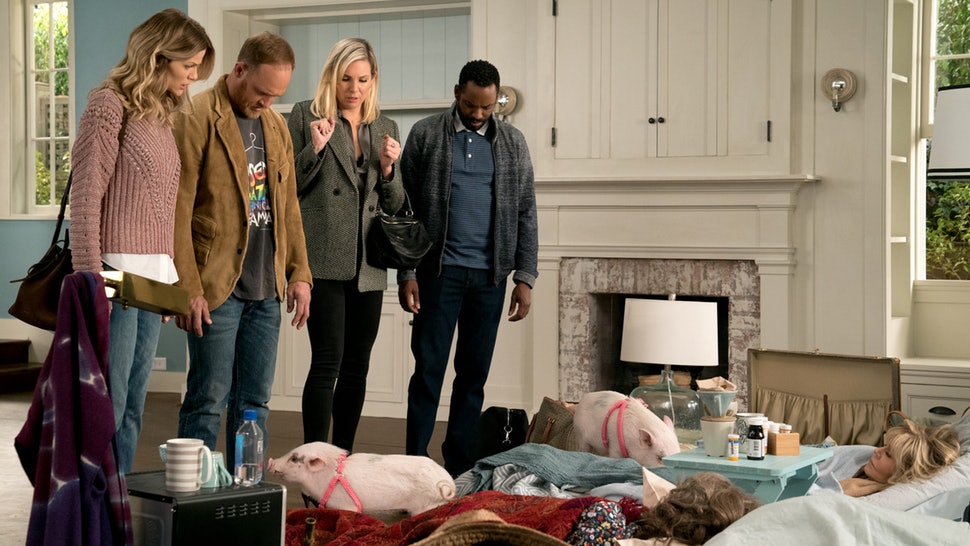
The Children.

Neo Classical Criticism – Logos, pathos & ethos

In this post, I will be applying the neo classical criticism method.Three persuasive factors can be used as part of the neo classical method: logos, pathos, and ethos. Logos is used to appeal to reason. It convinces the audience by using logic and reason. Pathos refers to appealing to emotion. It draws the audience in to help connect with the argument emotionally. Ethos can be broken down into three parts: good sense, good will, and good morals. It is the appeal to character. Using all three of these factors are modes of persuasion used to convince audiences. 

In the series, Grace and Frankie, I believe the use of all three persuasive factors are used often. In particular, humor and pathos is used throughout every episode, so I will be focusing on pathos, and how the audience can connect with both characters, Grace and Frankie.

In Season one, Episode three, “The Dinner,” the shock and humiliation from the break-up and discovery of their husbands is still very fresh (for everyone), and a family dinner is being held without Grace and Frankie present. This is the first family dinner that Robert and Sol are having as a gay couple together with all of their children in attendance. Separate conversations happen between Sol’s sons and Robert’s daughters in regards to the dinner:

Bud: “I feel weird.”

Coyote: “It’s all weird Bud. Our father, and his boyfriend are having their children over for dinner.”

Brianna: “If I’m going to this dinner, you’re going. And Mom can’t know about this! If you breathe one word about this to Mom, I will tell her who really killed dimples.”

Mallory: “What if she calls?!”

The children are all beginning to feel guilty as the dinner is hours away. They are feeling remorse because they feel as if they are going behind both of their Mothers’ backs. This conversation is an example of pathos. We begin to feel the empathy that the children are having towards their Mothers. We all realize that Robert and Sol are the ones who lied and cheated for over twenty years to everyone about their relationship, so why should they have to attend this family dinner with their Dads? Bud, Coyote, Brianna, and Mallory all make it to dinner and seem to get through it in a civil manner at first, but then Bud goes into the kitchen (where Brianna is secretly taking sips of alcohol). It becomes clear that this dinner should not be happening judging by Brianna and Bud’s conversation regarding their Dads being together:

Brianna: “Would you be cool with it, if they were cheating with women for the last twenty years?”

Bud: “I don’t know.”

Brianna: “Please! There wouldn’t be cake. <Pointing to the cake that Bud is about to carry out back to the dinner table, for dessert.> There would be blood. Or bullets. Or something. For sure, we wouldn’t be talking about the chicken.”

Bud: “Do you think you’re the only one that’s having a hard time? Up until a week ago, I was under the impression that my parents loved each other, now I’m losing my family, I’m losing Jewish Christmas eve…”

Plenty of emotions are being present in this particular scene and the conversation that is taking place between Brianna and Bud. They realized that if Robert and Sol both cheated on their Moms with women, none of them would be supportive or present at this dinner. Here we begin to realize and see the discomfort with Sol and Robert being finally out in the open.The audience is being drawn in, and able to connect in some sort of way with all these characters. Whether it’s feeling guilt for going behind your mother’s back and lying to her, having to go or see someone else go through a divorce, losing a loved one, having your own parents divorced, family members coming out for the first time, cheating, being cheated on, or angry at your Dads for putting your Mothers through this. At the end of this family get together, during dessert, the children all let their Dads here how they really feel about being there. They are all upset, angry, and hold nothing back. Bud says something in particular that really draws us in and makes us feel for Grace and Frankie at that moment:

Bud: “I am not even allowed to be mad!”

Sol: “Why not?”

Bud: “Cause you’re gay! If you were f@$*ing around with a woman for the last twenty years, we wouldn’t even be here, eating cake! <Stands up and picks up cake, and walks out.>. So we are not eating cake.”

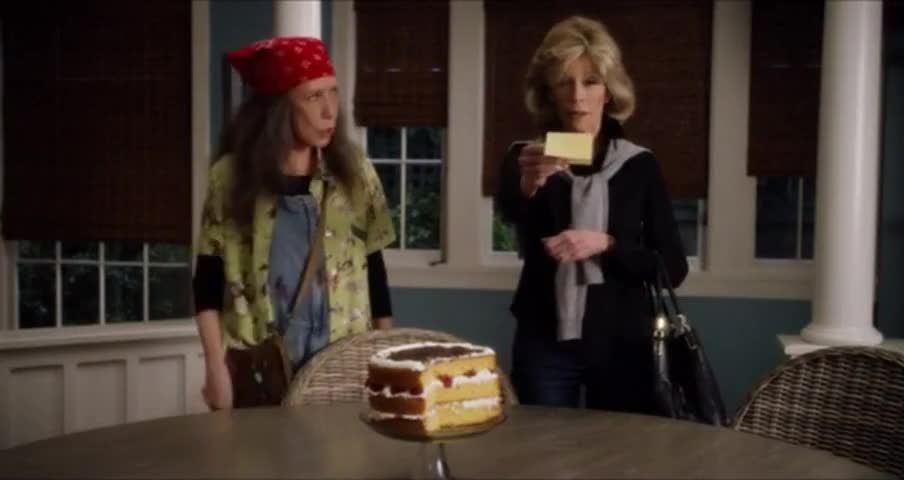
The cake is a subtle dig at Robert and Sol that they are “having their cake and eating it too.”  It’s not about them being gay, but how they were selfish. Overall, this series is about navigating life as older women, as they try dating, find new direction, and go through the frustrating details of divorce, all while using both humor and pathos. The children play an important role in this series and in this episode in particular. The audience gets drawn into the argument and feels what Grace and Frankie must be experiencing, and all other characters as well. It moves me, because how can you not feel sorry for them, for all of them? Especially during the moment when the children stood up and spoke up for them themselves. The emotions being felt here moves us, the audience, which makes this method effective.

The Cake.

Criticism Post #3 – Revised

4th Persona

In this week’s post, I will be writing about the fourth persona and apply it to an episode from the show, Grace and Frankie. From our class reading, Charles Morris defines the fourth persona as an audience that is created by the hidden messages in a text, which he refers to as a textual wink. Morris also refers to two passing audiences, while using the fourth persona, called the dupes and clairvoyants. When one is clairvoyant, you understand what the message is. You are considered a dupe if you miss the message.   

In Season 2, Episode 9, Robert and Sol are separated, because Sol cheated on Robert with his ex-wife, Frankie, which to Robert, is unforgivable and the absolute worst thing he could do. Robert’s friend Peter, (who is in an open relationship with his husband, Jeff), tells Robert he needs to get out of the house and to stop feeling sorry for himself over his separation with Sol. He makes Robert go with him and his dog, Tina, to the dog park. Robert soon realizes,  “there’s not many women around here.”

For example:

Peter: “Because Tina needs to socialize and so do you.”

Tina is Peter’s dog and here Peter is trying to convince Robert that he needs to get out  and socialize. What is implied here, is that Peter suggests that he needs to see who else is out there and to start meeting other men. Unless you knew Peter’s character from the previous episodes, the audience wouldn’t understand what Peter was really saying, if they just started watching, or if they were just a dupe.

Peter: “Okay, so he just signaled he wants to have sex with me.”

Robert: “What?! How did you get that?”

Peter: “Because ‘Hi’ meant with ‘Hi’ <nods head> sometimes means ‘well hellooo.’”

Here, Robert is the dupe. Peter is trying to explain to Robert what is really happening at the dog park and the real purpose of their visit, which is to see and/or sleep with other men. That is why the fourth persona is a key factor to this argument, because the audience might not even know what is really going on with these characters unless they are gay or understand gay lives. Robert is still new to being gay and so he is not clairvoynant to the messages implied at this particular park, either. The audience may be learning at the same time Rober’s character is learning about the different innuendos gay men may say to each other, that mean more than what is actually said.

In our class reading by Morris, he says, “The motto of the fourth persona: it takes one to know one,” (pg. 631). I believe this is true to this episode, because you have to know/be apart of gay lives to understand what is actually going on and being said. In this case, Robert was still new to the scene of publicly being gay, so even though he (was) is in a gay relationship, he didn’t understand at first what was going on, and what was actually being implied, by going to the dog park. This is the textual wink, and this is why this method works with this particular episode.

Criticism Post #2 – Revised

Neo Classical Criticism – The Canon

In this post, I will be applying the neo classical criticism method. The neo classical criticism method comes in two parts. The first part is called the canon, and this is what I will be using. There are five parts that make up the canon: Invention, arrangement, style, arrangement, and memory. I will not be applying all five of these parts to the episode that I will be referring to, but I will briefly explain what each of these parts of the canon are from our class notes:

  • Invention – How did they come up with it, inspiration, how did they generate it.
  • Arrangement – Putting it in order and why is it ordered this way. 
  • Style – Has to do with the person’s style/delivery, embellishment. 
  • Delivery – How is it delivered: gestures, movement, etc. How long are episodes, etc.
  • Memory – What makes it memorable, why isn’t it memorable?

The canon can be applied to Grace and Frankie, Season 2, Episode 3, when Grace and Frankie embark on their journey to invent and sell vibrators, geared towards an older consumer. The inspiration for a vibrator started when their best friend, Babe, passed away. Grace was given a vibrator from Babe’s will, and Babe wrote her a note telling her, “It won’t break your heart.” Grace ends up injuring herself after using it for the first time, because it wasn’t adequately equipped for women her age. They did not realize they were going to invent and sell vibrators, until the delivery of this idea first came out when they were both very angry at their children and ex-husbands. It just kind of blurted out when they were yelling at them, during the heat of the moment. They were supposed to be celebrating Frankie and Sol’s son, Bud, his birthday, but instead were too angry at everyone to enjoy it. Bud’s birthday may have been ruined, but a new business benefited from the ruined celebration in Grace and Frankie favor.

The style for Grace and Frankie’s new product was carefully thought out for their customers they had in mind. Even though they were offered a deal to purchase their product by a well known company, they didn’t like how they were trying to market their vibrators by misleading photos of themselves looking younger. They wanted to stay true to their age, and their real appearance, so they decided to sell it directly from  themselves only, which was through their website and online store they created. Not only was their branding for marketing a success, but the carefully designed product became a huge success, and so was their journey of being new business owners together.

The memory is the product Grace and Frankie invented, a vibrator. It makes this very memorable because it puts into perspective on how elderly people live their lives, and we forget how human we all are, no matter what age. Creating something like this,  geared towards seniors, is something that makes this product one of a kind. Also, the name of the vibrator, Vybrant, and how it’s spelled is memorable in itself. Other episodes continue to go into more detail on Grace and Frankie’s new business that leave a lasting impression we can not forget.

The canon method works and is a great way to explain Grace and Frankie’s new business journey. From the delivery of how it first came out and was announced, to the style of the product, and the lasting memory it has on everyone, not only in the show, but all who watch the show as well.

Criticism Post #1 – Revised

Rhetorical Situation

In this post, I will be applying the rhetorical situation method. “The rhetorical situation can refer to the speaker, the subject, the occasion, speech, audience, anything surrounding or impacting what may be said,” (Bitzer, p.46). From our class notes, we learned that rhetorical situations can be explained into three parts. First there is

exigence, which asks does this need to happen? It is an event that calls for us to speak about, so what is the thing that they needed to speak on? Second, there are audiences, which is figuring out who the actual audience is. Who is the intended audience for?

Lastly, there are constraints/opportunities, which is what can you say? Why can you not say? Constraints are what you can’t do, and opportunities enable you to do. The main goal of this method is to determine if it is a fitting response to the exigence. I will give a brief introduction to the show, then I will be applying the method to it, and determine if what happened was a fitting response.

In the Netflix series Grace and Frankie, two women, who were not friends in the first place, who also have complete opposite personalities, end up living with each other after their husbands leave them. Their husbands, Robert and Sol, are business partners at a law firm, and have been secretly in love with each other for the last twenty years of their marriages. They finally come out and tell Grace and Frankie the news, over dinner together, because they want to finally marry each other.

In this series, we witness Grace and Frankie’s world flip upside down under this bizarre circumstance, and see how they overcome this and many other life-altering events that take place. A running theme we see throughout the episodes is learning to adapt to your new reality. That no matter how old you are, (Grace and Frankie are both in their 70’s), it is never too late for new beginnings and new memories.

In Season one, Episode one, Grace and Frankie’s lives begin to unravel in the first few minutes of the show. The rhetorical situation takes place when Robert and Sol announce that they are not only leaving them (Grace and Frankie), but that they are also in love with each other. The exigence of the rhetorical situation is when Robert and Sol make this announcement at dinner:

Robert: “I’m leaving you. And he’s leaving you.”

Grace: “Who is she?”

Robert: “Oh it’s not what you think. It’s a He. And it’s Sol. I’m in love with Sol. Sol and I are in love.”

Frankie: “My Sol?!?”

Sol: “Your Sol.

The audience is Grace and Frankie since they are being presented with this new information, and it was intended only for them. However, the audience is also all the other people eating dinner at the restaurant, where this announcement took place, because Grace makes sure to cause a scene, so others may witness and hear this news as well. The audience also later becomes Grace and Frankie’s children as well, when they get informed about the situation taking place.

The constraints/opportunities involve all the characters in this episode, because they all take an effect on the situation that occurred. (They are also all key characters throughout the entire series). The characters involved are: Robert, Sol, Grace, Frankie, and all of their children, who find out about the news the day after Grace and Frankie were told about the divorce. Sol and Frankie’s two sons find out first, Bud and Coyote, when they are invited over to their parents’ house. Shortly after, Robert and Grace’s two daughters, Mallory and Brianna, find out from Bud and Coyote, before they arrive at their parents’ house for dinner, which Grace and Robert were not planning on telling them just yet. All of their children are adults, with very different personalities, living very different lives, (which we also get to witness throughout the series). They all take part in this situation that is unfolding in the beginning of the show, and it continues to unfold over the next five seasons.

I believe the exigence is very fitting, because it not only sets up what this episode is about, but what Robert and Sol say to Grace and Frankie, sets up why this entire series exists. How Grace and Frankie react to it is also what creates this series, and shows how your life can be turned upside down in an instant. The way the kids react to this, is an ongoing event throughout the series as well. This first episode gives an introduction to the constraints/opportunities all these characters have dealing with Robert and Sol’s announcement. This was a good example of the rhetorical method, because it’s a good response to what is unfolding in the episode/series. Without all the characters responses and reactions towards the exigence taking place, the show could not be successful.

Criticism Post #8

Grace And Frankie

Framing

This week I chose to write about the theory, framing. From our in-class notes, we learned that framing consists of eight different poetic frames: tragic, comic, epic, elegy, satire, burlesque, grotesque, and didactic. Tragic emphasises on punishment and leads to closure and scapegoats, to relieve collective guilt/sin. Comic emphasises humility, self-awareness and reflection, and shared responsibility, which leads to conversation and action. Epic pairs a hero/heroine with grand-scale context, and leads to the elevation of an individual. Elegy is the victim, who is passive, and resigned to a situation. Satire rejects flaws and scapegoats others who portray a weakness in an effort to unmake the flaw. Burlesque makes fun of flaws/faults, not to attack the position or flaw, but just to make fun. Grotesque is reductive, and favors entertainment/gratification, with an emphasis on the absurd, without seeking reform. And finally, didactic is suppression of the imagination to advance an agenda. When applying framing, the main goal is to see how the story is told and what is revealed by the rhetor’s worldview. I will be applying the frame, epic, to my chosen text. “Epic, an acceptance frame that celebrates the ideals of the dominating order through the admiration of a hero who embodies the ideal attitudes and goals of the community,” (Buerkle, pg 191).

In this particular post, I will not be focusing on a specific season or episode, but instead, I will be focusing on a specific, main character that tends to always play the same role throughout the Netflix series, Grace and Frankie. I will be discussing Grace, one of the main characters in Grace and Frankie. If you watch the shows, you know there is no Grace without Frankie and vice versa. I believe Grace and Frankie each play a specific role towards each other. I believe the rhetor uses Grace’s character to play a more epic role towards Frankie, and we can see it throughout the series.

Frankie always seems to get herself caught up in some situation, where in the end, she must rely on Grace to come in and save the day. Frankie also depends on Grace to remember things for her, because she knows Grace is good at keeping schedules and staying organized, which is the complete opposite of Frankie. I will list a few examples of how Grace always comes in to save the day. Frankie went out to eat with a friend and they both forgot their wallets, Grace came to the rescue to pay for their meal. Frankie accidently posted a tweet on their company twitter profile that they would give out free donuts and vibrators to whomever retweets the tweet she posted. Grace had to come in and clean up the mess, by coming up with a public apology to everyone, so their business would not be affected by Frankie’s recklessness. Frankie always loses something, but Grace is always the one to find it for her. One time, Frankie challenged a time limit on a crosswalk, so she had as many people as she could walk the crosswalk slowly, so more time could be added to it. Frankie almost accomplished adding that extra time, until a team of crossfit athletes ran across it. Grace showed up at the very end, to Frankie’s rescue, and walked that crosswalk so slowly, getting the added extra time to the crosswalk for Frankie. Grace saves Frankie when she gets injured, sick or gets a broken heart. Grace is always there for Frankie. 

I believe the frame, epic, applies to my theory of Grace’s character towards Frankie being heroic. The audience can see that the rhetor’s goal of the worldview for Grace is based on the frame epic from watching the series or in this case, by the examples I wrote about. Not only does Grace save Frankie throughout the series, but Frankie looks at Grace as someone who she can depend on and knows how heroic she is to her. I don’t believe this was ever Grace’s intention towards Frankie in the beginning, but as their relationship grew, (and the series grew), Grace’s character turns out to be a heroine for Frankie.

Criticism Post #7

Visual

I apologize to my readers for posting this one a little late. For criticism post seven, I have decided to focus on one of our newer theories we have learned, which is visual rhetorical criticism. In our class slide presentation on the theory visual, we learned that there are five visual aspects to consider while analyzing. Syntax is when you consider the meaning and the message of the visuals, for example, what the text is trying to say visually, like the overall message. Pragmatism focuses on whether or not it works, for example, how practical the message is, and which audience does it appeal to. Codes looks at how meaning is layered, for example, images often have codes for other meanings, and how this code affects the overall meaning. Composition unpacks how exactly it’s all put together, for example, the background, props, colors, and what is included in that specific frame. Finally, the gaze considers who looks, who is looked at, and how that relates to power, for example, how the audience’s eye is drawn to the text, and what the people in the text are looking at. Overall, when analyzing visual theory, we want to be able to understand how visual elements can move an audience. In the text I am about to analyze, I will focus mainly on the visual codes and composition.“A detailed analysis of illustrated imagery and the function of color demonstrate the rhetorical force toward narration and ideology possible in the visual form,” (Wolfe, The Lorax).

In season four, episode thirteen, “The Home,” Grace and Frankie are living in assisted living. I have previously mentioned in a past post, how Grace and Frankie’s children tricked them into living here. In this post, I am going to focus on the short time that they did live in the assisted living, and apply it to the theory. There is a scene in this episode where Grace and Frankie attended a class which focused on, “looking great and feeling good,” that had to do with new, comfortable clothing, where the key audience is obviously towards older people, seniors. As an audience ourselves, we can imagine these outfits based on what we see most seniors wearing. From watching the show, we also are well aware of Grace and Frankie’s specific style and choice in clothing, and these senior outfits are far from each of their unique styles. Frankie wears baggy clothing, mostly muumuus, which are bold colors and prints, with big, colorful jewelry as an accessory. Grace’s style is very sophisticated, that mostly consists of popped up collared blouses and slacks, with some type of heel. Grace and Frankie are in these senior outfits and we see that they definitely don’t look right on them based on their characters in the show. 

“Well, you have to admit these clothes feel comfortable. Grace, how do your knees feel in those shoes?” – Friend of Grace and Frankie, whom also lives at Walden Villas.

In the next scene, Frankie’s boyfriend has been on business for the past two months and doesn’t know that she now lives at Walden Villas. He finds out and finds her at this class, wearing these senior clothes. They go for a walk around the outdoor grounds of the assisted living and discuss how she ended up living there.

“It’s not understandable. I come back to town, and you are in a home!” – Nick 

“This is a retirement community.” – Grace

“What difference does it make, you don’t belong here.” – Nick

“Look, I may have ended up here a little early, but I’m gonna end up here anyway.” – Grace

It’s clear at this point, that the audience knows, and other characters, like Nick, know that Grace and Frankie not only do not belong in those senior clothes, but also do not belong in the senior living retirement home. 

We know that Grace and Frankie do not belong at Walden Villas based on what we see visually going on in these two scenes. Which is the overall message, the syntax of this message is that judging by what everyone wears, and looks like, Grace and Frankie do not belong. The visual codes that we see that make the overall message are the senior outfits they are wearing. They are loose, jump suits, with foam visors, fanny pack, and velcro tennis shoes. The colors they chose, which have to do with the composition as well, are light and pastel, which we also can view as a more gentle, comfortable clothing – which are perfect for seniors to wear. When Grace and Nick are walking on the walk path, we notice in the background another couple, struggling to walk, with the use of their canes, and notice them having to take a break on a nearby bench. We also see in the background a group of seniors wearing the senior outfits in a fitness class, where they are all sitting down in chairs, doing some basic arm movement. We can see Grace and Frankie are physically fit, and in no capacity like the other seniors’ health at the assisted living. 

Using these visual elements makes it easy to understand that the rhetor was trying to deliver the message, which is that Grace and Frankie do not fit in at the senior retirement home. I believe it succeeded at establishing the delivery of this message. The rhetor used color in the senior clothing and the camera view, which focused on Grace and/or Frankie, with the struggling seniors in the background, showing that they stand out amongst the other seniors living there. I believe these visual aspects moved the audience and gave us a clear picture of the message.

Criticism Post #6

Narrative

I have mentioned previously in my posts how the children of Grace and Frankie play an important role in the series. Today’s post will focus on one of Grace’s daughters, Brianna, and her relationship with her boyfriend/employee, Barry. 

I have chosen Narrative for this criticism post. From our class notes, narrative includes several story elements: plot, characters, conflict, setting, tone, and theme. The purpose of Narrative is fidelity – is it true to life? Does it have coherence? Author Mikhail Bakhtin, uses the term heteroglossia, to help describe, from what I understand is, the direct narrative of the author, instead of the dialogue between the characters. I will be identifying all these elements that make the narrative, as I explain what is happening in two of the episodes between Brianna and Barry.

As previously mentioned, Brianna and Barry are the characters for this narrative. The setting is in Brianna and Barry’s place of work, Say Grace. The plot is about Brianna and Barry’s relationship and whether they are moving in the right direction, together or further apart. In season 6, episode 11, “The Laughing Stock,” Brianna is offered a promotion in San Francisco. The conflict is before discussing it with Barry, (who recently moved in with her), she decides herself that she would take the job and assumes Barry would just go along with it. The way she brings it up to him, is by talking about having more closet space and a chance to buy a place of their own together. Barry is excited and then hears it’s only because she took a job in San Francisco and that is the only reason why she is considering moving to a new place (with him). 

Barry, “I can’t believe you did this.”

Brianna, “I know. Look at me, I’m really thinking about our future.”

Barry, “You mean your future.”

In season 6, episode 13, “The Change,” begins with Barry returning from a mini solo vacation and he doesn’t know that Brianna ended up turning down the job promotion. He spent time thinking about their relationship and believes Brianna doesn’t see or want a more permanent commitment with him. This is an example of narrative fidelity, because I believe we can all relate to relationship issues where we don’t see eye-to-eye and might be in different places in the relationship, then our partners. Barry decides to break-up with Brianna. After Brianna takes some time herself thinking about their relationship, she ends up getting on one knee and proposes to Barry. She proposes to get engaged and to stay engaged, forever. Brianna later explains to her Mom and Frankie that, “I had to come up with something, I know it’s unconventional, but it works for us.”  The tone for this narrative stays positive and hopeful overall, because the theme of the narrative is clear that relationships have their own problems, and are unique and different. It’s what’s finding what works best between those involved in the relationship. This theme shows narrative coherence, because this is relatable to everyone who’s been in a relationship. Relationships are never perfect and never the same. 

In conclusion, this narrative about Brianna and Barry is significant to the audience because it’s relatable, and we can easily see all the elements present in the narrative and why it works. Bakhtin’s term, heteroglossia, is present and can be understood in this narrative, because the author of these episodes wanted to show the audience that just because something is unconventional to how we usually see/do things, doesn’t make it wrong. Trying to find what works best for you, or in this case Brianna and Barry’s commitment to each other, is what’s important in life…

And they lived happily ever after! Their way!

Criticism Post #5

Pentad

As Burke (1969) wrote, he proposed his pentad to help explain ‘‘what is involved, when we say what people are doing and why they are doing it’’ (p. xv). In this post, I will apply the theory of pentad to Grace and Frankie, season four. As Burke states, there are five areas of analysis and can be explained by the following:

1. It is helpful to create lists with each area

2. Look at relationships btw areas to generate more notes I.e ratio analysis (one will often dominate as the key aspect of the story) 

  • Act –  (What took place, in thought or deed, symbolic: communities response, comm. that happened as a result) 
  • Agent –  (Person who performed the act, roles, attitudes/position, collective individuals) 
  • Scene –  (Background of the act, or the situation, includes time and space, community matters, has to be meaningful in some way) 
  • Agency –  (What means or instruments were used, the vehicle, how are they able to do it? Could be non-verbal)
  • Purpose –  (Stated goals/intent, not the same as motive, not what the “analyzer” interprets as the reason) 

3. Decide what is the “dominant” aspect, and: 

4. What the dominant area says about the real motive (not to be confused with the stated purpose).

Over the course of season four, many things happen to Grace and Frankie, including their house beginning to fall apart, which they attempt to get it fixed, only to be scammed and robbed. They also both find themselves being stuck on the floor due to their backs giving out, Grace has to have knee surgery, she gets caught for drinking in public and riding a scooter into a parked cop car, and Frankie gets lost driving around her granddaughter, while following an ice cream truck and ends up at the Mexico border. These are some of the events that occur, which they do try to keep from everyone, including their children. When their children discover these events that took place, they become very concerned for their Mothers.

In the very last episode of season 4, episode 13, Grace and Frankie’s children decide between the four of them, that it’s time their Moms need to move into an assisted living, based off a check-list they found online, which lists signs that they (their parents) are ready for assisted living. At first, Grace and Frankie both refuse to go. After the kids confront each parent alone, they manage to trick them into believing they need to do this for the sake of each other.

Breanna to Frankie, about Grace, her Mom: “Maybe you don’t need to be there, but she does, and we can’t imagine her going anywhere without you.” 

Bud to Grace, about Frankie, his Mom: “She would never go anywhere without you again.”

And just like that, the kids convince them to move into assisted living. Two months pass by, while they are living in their new assisted living called, Walden Villas. The kids put the house up for sale, but do not tell Grace and Frankie it sold. Meanwhile, Grace and Frankie realize they were both tricked into living there for eachother and decided to leave and go back to their beach house.

Grace to Frankie: “Since we came here for eachother, can we leave for each other?”

Frankie to Grace: “Done.”

They leave Walden Villas without telling anyone, and go back to their home, only to discover it was sold.

Symbolic Act: The kids taking care of their aging Mothers, and moving Grace and Frankie  into assisted living.

Scene: At Grace and Frankie’s beach house and also the assisted living where they moved to, called the Walden Villas.

Agent: The kids of Grace and Frankie: Bud, Coyote, Breanna, and Mallory. Grace and Frankie, the Mothers of the kids.

Agency: The kids convince their moms that they need to move for the sake of each other. They trick them into moving into the assisted living home, the Walden Villas.

Purpose: Grace and Frankie thought they were helping each other out, by moving to assisted living for each other.

The dominant aspect of this pentad theory was the Purpose. It’s the most important part, because Grace and Frankie will do anything and everything for each other. Just like they moved in for each other at the Walden Villas, they move out and fight together to get their beach house back.

Design a site like this with WordPress.com
Get started